
quick sidenote:
it’s been 16 days since i started the series. i honestly did not think it would mean so much to so many of you. (over 12,000 folks have come to the blog now)
the dms i've gotten are humbling. thank you. but it’s not the number that gets me. it’s the messages
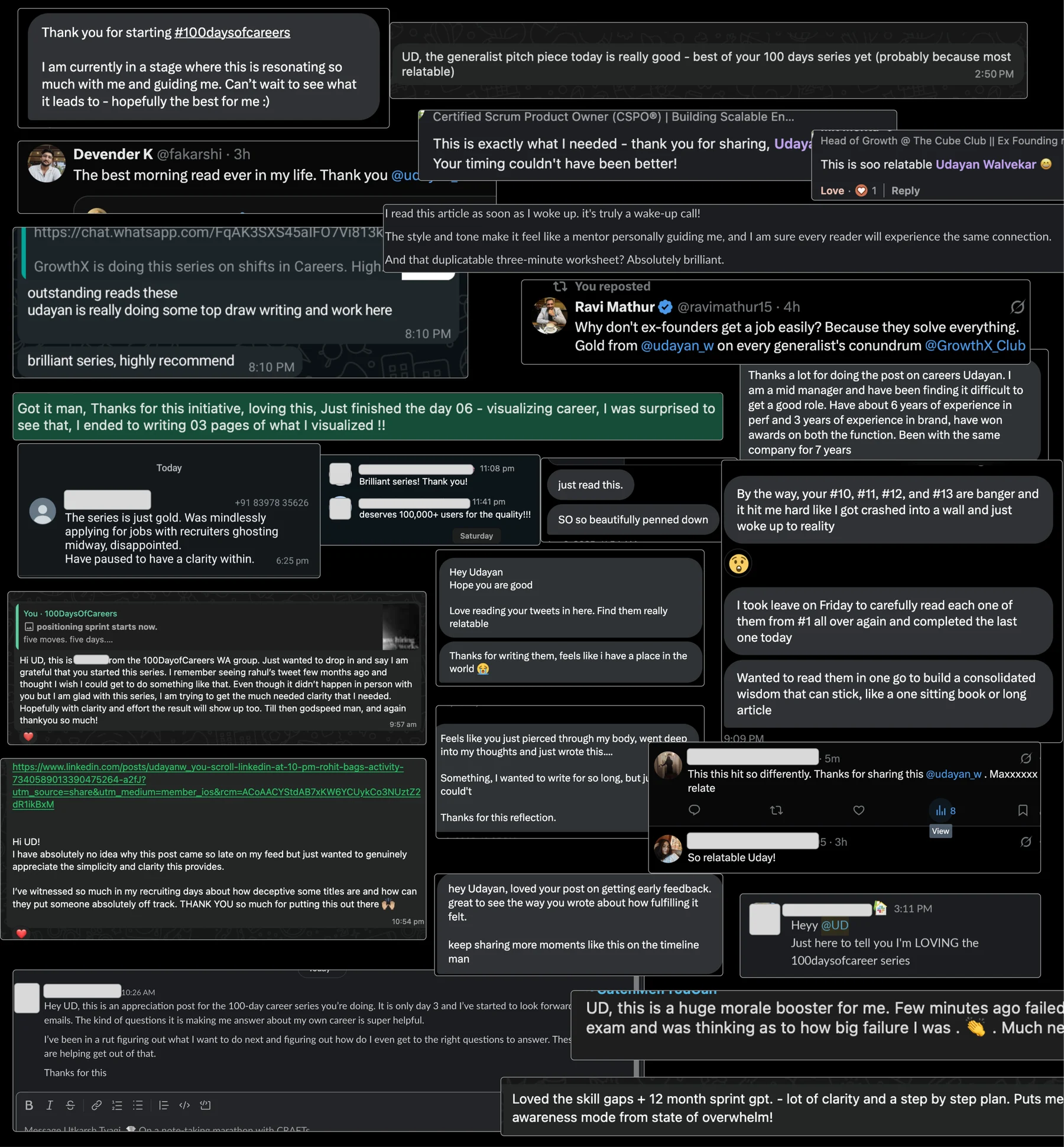
some of them make me stop look up and just say thank you i dropped out of engineering spent 2 years without a job felt like a failure most of that time. so the fact that i get to help someone in that awkward, stuck, confused place feels like a privilege.
i’m sharing this here to tell you you’re not alone. whatever you’re feeling right now someone else is too.
now let’s get back to day 17
just a quick recap, we’ve covered
understanding the problem
getting clear on a direction
how to solve for positioning
we have entered the next arc.
how to actually land the role.
getting shortlisted. building
proof of work that actually
works. cold dms. interviews.
culture fit. negotiation.
the whole thing.
this arc will run for at least 14 days.
it will work no matter what function you're in. just do the small actions after every article. you'll look back in two weeks and be amazed at what you've built.
so where do we start?
we start with the single biggest point of failure. getting shortlisted. whether it’s at the cv stage, screening stage or the intro call with the hiring manager.
your cv & you are at fault
you're cv trying to sell a new future but the document only wants to talk about your past. your pitch does the same thing. you only pitch about your past.
for the next 5 mins i want you to forget what a cv and your pitch is supposed to do. before we solve anything we have to burn down the old idea.
what you think happens
hiring manager reads your experience. sees you've done similar work. recognizes your competence. calls you.
what actually happens
they glance at company logos. make instant assumptions. project whether you'll handle their specific mess. decide in seven seconds.
they're not evaluating your past.
they're betting on your future.
and you're giving them the
wrong data to make that bet.
there is a GAP
between evaluating your past
vs betting on your future.
let’s understand the gaps.
the 4 gaps we need to solve.
1/ context translation
you built features for 100 million users at uber. impressive. but they're a series a startup with 50k users. can you build with different constraints? no product market fit. no data. no team. just speed and intuition.
at google, you optimized existing systems. here they need someone to build from zero. at zomato, you had a 20 person team. here you'll code yourself.
sure, you might be smart.
but they're wondering if you
can operate without the
infrastructure you're used to.
this is context translation.
this is not about “skillsets or projects” listed on your cv. this also happens vice versa i.e. going from a small startup to a large one.
different stages need different muscles.
2/ problem alignment
you solved merchant retention at swiggy. great. but their problem is merchant onboarding in tier 3 cities. completely different challenge. different constraints. different physics.
unless you make the connection explicit,
they won't make it for you.
problem alignment can be at a industry level, user level or tech stack level.
3/ brand bias
here's the uncomfortable truth.
your company's brand is doing 70%
of the work. for or against you.
if you're at a hot company
they assume you're good by
association. "must be sharp if
they thrived at razorpay."
at an unknown startup?
you're fighting uphill.
every claim needs extra proof.
at a traditional company?
tech startups assume
you can't move fast.
at a failed startup?
they wonder if you were
part of the problem.
unfair? absolutely.
reality? unfortunately.
but brand bias has an expiry date.
after the first five minutes, they start looking deeper. that's when the real assessment begins. "okay, they're from a good company. but can they solve MY problem?"
4/ hiring manager's mental math
let me break down exactly what's happening in their head. i've been on both sides of this table 100+ times.
min 1-2: brand assessment
"what companies. what titles. what trajectory."
min 3-5: pattern matching
"have they solved similar problems? similar scale? similar constraints?"
min 6-10: skill verification
"are they bullshitting or do they actually know this space?"
min 11-15: culture fit
"will they thrive here or hate it in three months?"
min 16-20: conviction building
"am i confident they'll solve our specific problem?"
notice what's missing?
your years of experience.
your fancy frameworks.
your certificates.
they're running one calculation:
risk versus reward of betting on you.
let’s see how we can solve this?
follow these 5 steps.
step 1: decode their actual problem
not the job description.
the real problem.
we’ve covered this in this article.
go read it. don’t skip this step no matter what.
step 2: list your proof points
for each problem ask yourself:
have you solved something similar?
what was the core challenge?
how did you approach it?
what actually changed?
write it down.
don’t think of the answer in your head.
step 3: identify the gaps
be brutally honest:
what haven't I done that they need?
where's my experience thin?
which contexts haven't I operated in?
what would make them nervous about you?
step 4: build your bridge statements
for each gap, you need a bridge:
"i haven't built for tier 3 markets, but i've built for price sensitive segments at company x. learned that trust beats features when users have limited internet."
"haven't worked at 20 person startups, but joined my last company at 100 people when nothing was documented. built the first design system from scratch."
"haven't done b2b saas, but worked with b2b2c at flipkart where merchants were our primary customer. same dynamics of churn and onboarding."
step 5: create your trust ladder
list that make you credible:
specific problems you've solved
contexts you've operated in
results you've delivered
people who'll vouch for you
list what makes you risky:
experiences you lack
contexts you haven't seen
skills you're still building
assumptions they might make
despite this, you’ll have gaps where you just don’t have what they are looking for. i want you to come back with 2-3 of those.
because gap between these lists?
that's our work for the next 1 week.
starting tomorrow.
we will solve this with proof. not the proof of work that gets appreciation from your peers or looks cool. but the ones that the hiring manager cares about.